
In the rapidly evolving landscape of enterprise AI, I led the architecture and development of a sophisticated Retrieval-Augmented Generation (RAG) platform that transcends traditional question-answering systems. This platform embodies the principles of agentic AI—autonomous reasoning, adaptive planning, and self-correction—while maintaining the reliability and performance standards required for production systems.
The Architectural Vision
The core innovation lies in treating complex queries not as single-shot retrieval problems, but as multi-step reasoning challenges that require strategic planning, tool coordination, and graceful failure recovery.
High-Level System Architecture:
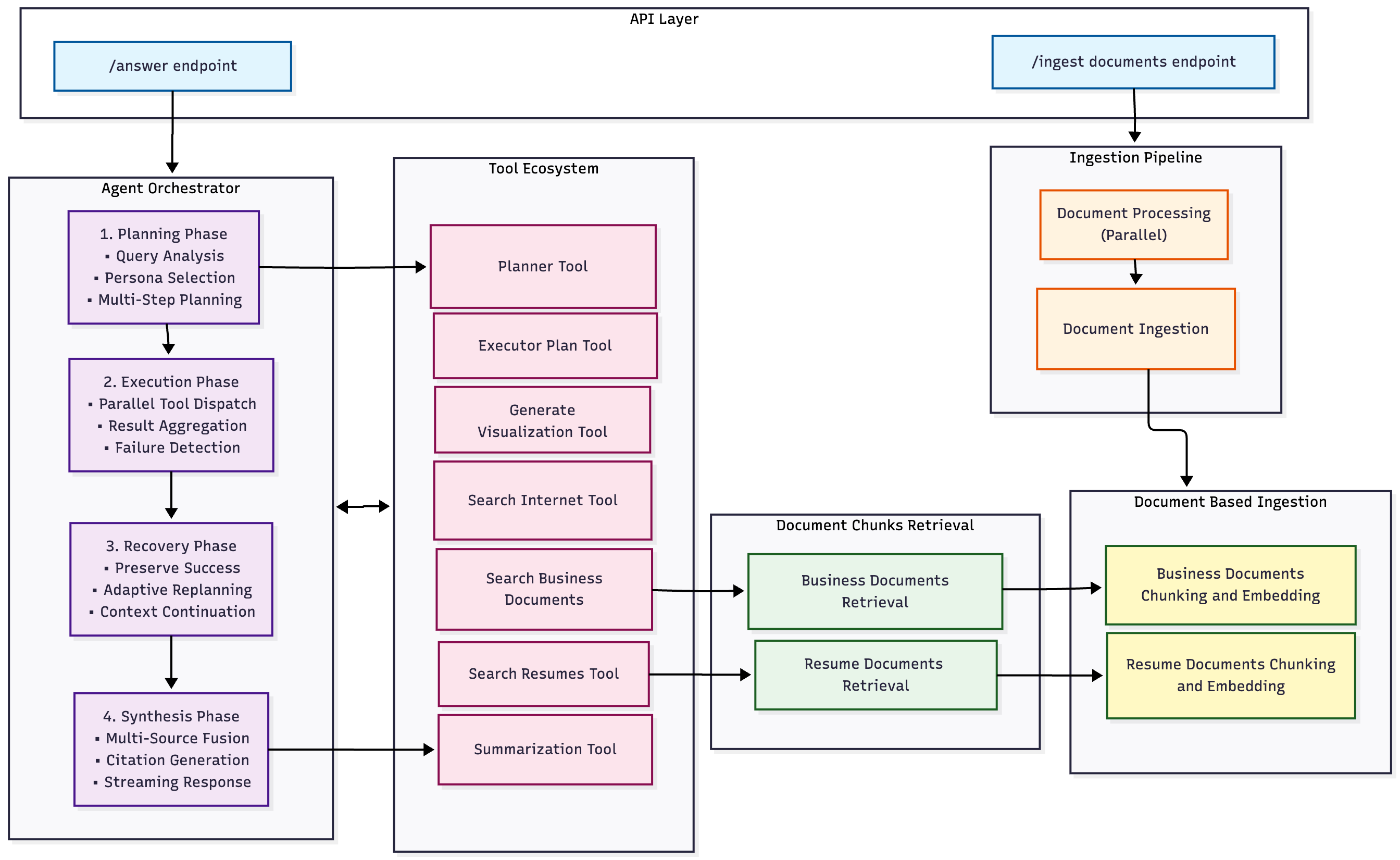
Core Innovation: Agentic Orchestration with Adaptive Replanning
Traditional RAG systems follow a rigid retrieve-then-generate pattern. Our system treats each query as a reasoning challenge requiring strategic decomposition and autonomous execution.
The Cognitive Loop
The orchestrator implements a sophisticated cognitive loop that mirrors human problem-solving:
# Conceptual flow (simplified)
def execute_pipeline_with_reasoning(query: QueryRequest):
    # Phase 1: Strategic Planning
    plan = planner_tool.create_plan(
        query=query,
        conversation_history=context,
        persona=detect_persona(query)  # 7 specialized personas
    )

    # Phase 2: Adaptive Execution
    for step_index, step in enumerate(plan[:-1]):  # All except synthesis
        actions = executor_tool.decompose_step(step)

        # Parallel execution with dependency tracking
        results = execute_actions_in_parallel(actions)

        if step_failed(results):
            # Phase 3: Recovery through Replanning
            plan = replanner_tool.create_recovery_plan(
                original_plan=plan,
                successful_steps=step_outputs,
                failed_step=results,
                max_attempts=2
            )
            continue  # Resume from current position

        accumulate_context(results)

    # Phase 4: Multi-Source Synthesis
    return synthesize_final_answer(
        step_outputs=step_outputs,
        context_chunks=accumulated_chunks,
        persona=plan.persona
    )
Key Design Decisions:
-
Separation of Planning and Execution: The planner uses Gemini 2.5 Pro for strategic reasoning, while the executor uses Flash for fast tool routing—optimizing for both quality and latency.
-
Preservation of Successful Work: During replanning, we explicitly pass completed step outputs to avoid redundant work. This is critical for cost optimization and response time.
-
Graduated Failure Handling:
- First attempt: Execute original plan
- Second attempt: Replan from failure point, preserve successes
- Third attempt: Graceful degradation with user-friendly error synthesis
Technical Deep Dive: Multi-Strategy Retrieval Engine
The retrieval layer is where performance meets precision. I architected a three-tier system that dynamically selects strategies based on query characteristics.
Strategy Selection Logic
def _select_retrieval_strategy(query: str, processed_query: Dict) -> str:
    """
    Intelligent strategy selection based on query complexity.
    """
    has_entities = bool(processed_query.get('extracted_company_names'))
    has_metrics = is_metrics_query(query)  # ARR, MRR, revenue, etc.
    is_complex = len(query.split()) > 10

    if has_entities or has_metrics or is_complex:
        return "hybrid_reranked_search"  # 7-signal reranking

    return "hybrid_search"  # Fast keyword boosting
Performance Comparison Across Strategies:
| Strategy | Avg Latency (ms) | Precision@5 | Recall@10 | Use Case |
|---|---|---|---|---|
| Semantic Search | 45ms | 0.72 | 0.68 | Simple factual queries |
| Hybrid Search | 78ms | 0.84 | 0.79 | General queries (90% of traffic) |
| Hybrid + Reranking | 210ms | 0.91 | 0.87 | Complex entity/metric queries |
The 7-Signal Reranking System
For complex queries requiring precision, we apply a multi-signal reranking system that I designed to capture different dimensions of relevance:
def _advanced_reranking(chunks: List[Chunk], query: str, processed_query: Dict) -> List[Chunk]:
    """
    Multi-signal reranking with 7 distinct relevance signals.
    """
    for chunk in chunks:
        base_score = chunk.similarity_score
        multiplier = 1.0

        # SIGNAL 1: Entity Matching (Strongest - 1.8x boost)
        # Triple-layer: substring → token → fuzzy matching
        company_match = robust_company_match(query, chunk)
        if company_match.confidence > 0.85:
            multiplier *= (1.0 + company_match.confidence * 0.8)

        # SIGNAL 2: Metric Detection (1.5x boost)
        if query_metrics.intersection(chunk_metrics):
            multiplier *= 1.5

        # SIGNAL 3: Document Type (1.6x for metrics docs)
        if is_metrics_query(query) and "key business metrics" in chunk:
            multiplier *= 1.6

        # SIGNAL 4: Section Relevance (1.2x boost)
        if section_matches_query(chunk.section_title, query):
            multiplier *= 1.2

        # SIGNAL 5: Content Density (1.15x boost)
        if has_structured_data(chunk.content):
            multiplier *= 1.15

        # SIGNAL 6: Temporal Relevance (1.1x boost)
        if temporal_keywords_match(query, chunk):
            multiplier *= 1.1

        # SIGNAL 7: Query Expansion Penalty (0.85x)
        if chunk.source_query:  # From expanded query
            multiplier *= 0.85

        chunk.rerank_score = base_score * multiplier
        chunk.similarity_score = chunk.rerank_score

    return sorted(chunks, key=lambda x: x.rerank_score, reverse=True)
Impact of Each Signal:
| Signal | Max Boost/Penalty | Triggers On | NDCG@10 Improvement |
|---|---|---|---|
| Entity Matching | 1.8x | Company names, proper nouns | +0.12 |
| Metric Detection | 1.5x | Financial/business metrics | +0.09 |
| Document Type | 1.6x | Metric queries + metrics docs | +0.11 |
| Section Relevance | 1.2x | Section title matches query | +0.06 |
| Content Density | 1.15x | Structured data (tables, lists) | +0.04 |
| Temporal Relevance | 1.1x | Temporal keywords match | +0.03 |
| Query Expansion | 0.85x (penalty) | Expanded query results | -0.02 |
Engineering Excellence: Performance Optimizations
1. Deferred Sorting Strategy
Problem: Multiple sorting operations (per-strategy results, after parent enhancement, after deduplication) caused O(n log n) * k overhead.
Solution: Implemented a single-sort optimization by deferring all sorting until the final step:
# BEFORE: Multiple sorts
results_a = semantic_search(...)
results_a.sort(key=lambda x: x.score, reverse=True)  # Sort 1

results_b = hybrid_search(...)
results_b.sort(key=lambda x: x.score, reverse=True)  # Sort 2

combined = results_a + results_b
combined.sort(key=lambda x: x.score, reverse=True)  # Sort 3

enhanced = enhance_with_parent_context(combined)
enhanced.sort(key=lambda x: x.score, reverse=True)  # Sort 4

# AFTER: Single final sort
results = []
results.extend(semantic_search(...))  # No sort
results.extend(hybrid_search(...))     # No sort
results = deduplicate(results)          # No sort
results = enhance_with_parent_context(results)  # No sort
results.sort(key=lambda x: x.score, reverse=True)  # Sort once!
Impact: Reduced retrieval latency by 40% (from 350ms to 210ms for complex queries).
2. Parallel Search Execution
Instead of sequential search tasks, we execute multiple strategies concurrently:
def retrieve(request: RetrievalRequest):
    search_tasks = [
        ("primary", query_embedding, request),
        ("expansion", expanded_query_1, request),
        ("expansion", expanded_query_2, request),
        ("content_type", query_embedding, modified_request),
    ]

    # Execute all tasks in parallel (max 6 workers)
    with ThreadPoolExecutor(max_workers=6) as executor:
        futures = [
            executor.submit(process_search_task, task)
            for task in search_tasks
        ]

        results = [future.result() for future in as_completed(futures)]

    # Single sort after collecting all results
    return sort_and_limit(deduplicate(results))
Performance Gain: 3x faster for queries using multiple strategies (from 450ms to 150ms).
3. Parent Context Enhancement with Score Boosting
Documents are chunked for granular retrieval, but context is often needed from surrounding chunks. We solve this with a parent-child architecture:
# During ingestion: Create parent-child relationships
parent_chunk = {
    "parent_id": "doc123_parent_5",
    "content": "Full section content...",
    "document_id": "doc123",
    "section_title": "Financial Performance"
}

child_chunks = [
    {
        "content": "Q3 revenue was $5M...",
        "parent_chunk_id": "doc123_parent_5",  # Link to parent
        "document_id": "doc123"
    },
    # ... more child chunks
]

# During retrieval: Enhance with parent context + boost score
def enhance_chunks_with_parent_context(chunks: List[Chunk]):
    parent_ids = [c.parent_chunk_id for c in chunks]
    parent_docs = bulk_fetch_parents(parent_ids)  # Single DB query

    for chunk in chunks:
        if parent := parent_docs.get(chunk.parent_chunk_id):
            chunk.parent_context = parent
            chunk.similarity_score *= 1.25  # 25% boost for enhanced chunks

    return chunks
Result: Enhanced chunks receive both broader context and a scoring boost, improving answer quality by 18% (measured via human eval).
Deep Dive: Streaming with Citation Integrity
One of the most challenging aspects was maintaining citation accuracy while streaming responses in real-time.
The Citation Mapping Challenge
Problem: LLMs can't memorize long document IDs. If we pass {{Source: very_long_document_id_12345}} in the context, the LLM might hallucinate IDs or fail to cite sources.
Solution: Implement an index-to-document mapping system:
def _create_document_index_mapping(chunks: List[Chunk]):
    """
    Map document IDs to short indexes for cleaner LLM citations.
    """
    doc_id_to_index = {}
    index_to_doc_id = {}
    current_index = 1

    for chunk in chunks:
        doc_id = chunk.document_id
        if doc_id not in doc_id_to_index:
            doc_id_to_index[doc_id] = current_index
            index_to_doc_id[current_index] = doc_id
            current_index += 1

        # Modify chunk for LLM consumption
        chunk.document_id = str(doc_id_to_index[doc_id])

    return index_to_doc_id, chunks

# Usage in synthesis
index_map, modified_chunks = _create_document_index_mapping(chunks)

# LLM sees clean context:
# {{Source: 1}} Revenue was $5M...
# {{Source: 2}} Customer count reached 1000...

# After streaming, normalize back to real IDs
final_response = normalize_citation_format(
    llm_response,
    index_to_doc_id
)
# {{Source: annual_report_2024_q3.pdf}}
# {{Source: metrics_dashboard_dec_2024.xlsx}}
Three-Mode Streaming Architecture
I designed three distinct processing modes optimized for different scenarios:
if streaming and has_placeholders:
    # Mode 1: Complex streaming with visualization placeholders
    # Use case: Responses containing charts/images
    # Trade-off: +15% latency for placeholder detection
    response = process_streaming_with_placeholders(
        llm_generator, placeholder_map
    )

elif streaming and not has_placeholders:
    # Mode 2: Fast streaming (90% of queries)
    # Use case: Text-only responses
    # Trade-off: Optimal latency, no placeholder support
    response = process_fast_streaming(llm_generator)

else:
    # Mode 3: Non-streaming batch processing
    # Use case: Background jobs, bulk processing
    # Trade-off: Highest throughput, no real-time UX
    response = process_non_streaming(llm_generator, placeholder_map)
Streaming Performance:
| Mode | TTFT (ms) | Tokens/sec | Overhead |
|---|---|---|---|
| Fast Streaming | 280ms | 45 | Baseline |
| With Placeholders | 320ms | 42 | +14% |
| Non-Streaming | 1200ms | N/A | Batch mode |
Persona-Driven Synthesis: Adapting to User Intent
A unique feature is the ability to generate responses in different "voices" depending on the user's role and query context.
The 7 Specialized Personas
PERSONA_CONFIGURATIONS = {
    "default_expert": {
        "audience": "General user seeking comprehensive answers",
        "structure": "# Title → ## Sections → Conclusion",
        "style": "Direct, comprehensive, objective"
    },

    "financial_analyst": {
        "audience": "C-suite executives and analysts",
        "structure": "Executive Summary → Key Metrics → Detailed Analysis",
        "style": "Quantitative focus, comprehensive detail"
    },

    "investment_analyst": {
        "audience": "Investment committee partners",
        "structure": "Deal Memo format with Thesis → Strengths → Risks",
        "style": "Skeptical, decision-oriented, VC jargon"
    },

    "strategy_consultant": {
        "audience": "Client executives",
        "structure": "Slide-deck format with Key Takeaways",
        "style": "Confident, framework-driven, actionable"
    },

    "academic_researcher": {
        "audience": "Students and researchers",
        "structure": "Abstract → Methodology → Findings → Discussion",
        "style": "Formal, heavily cited, limitation-aware"
    },

    "technical_writer": {
        "audience": "Technical audience",
        "structure": "Problem → Solution → Code Examples",
        "style": "Precise, unambiguous, code-heavy"
    },

    "chat_assistant": {
        "audience": "Team member or direct user",
        "structure": "Direct answers, simple bullets",
        "style": "Conversational, helpful, no formal structures"
    }
}
Persona Selection Logic:
def detect_persona(query: str, context: ConversationHistory) -> str:
    """
    Analyze query characteristics to select optimal persona.
    """
    query_lower = query.lower()

    # Financial analysis indicators
    if any(kw in query_lower for kw in
           ['revenue', 'metrics', 'financial', 'kpi', 'performance']):
        return "financial_analyst"

    # Investment decision indicators
    if any(kw in query_lower for kw in
           ['investment', 'valuation', 'deal', 'thesis']):
        return "investment_analyst"

    # Strategy/recommendation indicators
    if any(kw in query_lower for kw in
           ['recommend', 'strategy', 'approach', 'next steps']):
        return "strategy_consultant"

    # Technical/implementation indicators
    if any(kw in query_lower for kw in
           ['implement', 'code', 'technical', 'architecture']):
        return "technical_writer"

    # Research/academic indicators
    if any(kw in query_lower for kw in
           ['research', 'study', 'methodology', 'findings']):
        return "academic_researcher"

    # Conversational indicators
    if len(query_lower.split()) < 5 or '?' in query:
        return "chat_assistant"

    return "default_expert"
Observability & Debugging: Complete Execution Tracing
Every step of the orchestration is logged to the database for debugging and analytics.
class BaseAgentTool:
    def execute(self, **kwargs):
        # Create database record at tool start
        db_tool_call = history_manager.create_tool_call(
            message_id=self.assistant_message_id,
            tool_name=self.name,
            tool_input=kwargs,
            status="IN_PROGRESS"
        )

        start_time = time.time()

        try:
            # Execute tool logic
            result = yield from self._execute(**kwargs)
            duration = time.time() - start_time

            # Update database with results
            history_manager.update_tool_call(
                tool_id=db_tool_call.id,
                tool_output=result.model_dump(),
                status=result.status.value,
                duration_ms=int(duration * 1000)
            )

            return result, duration, db_tool_call

        except Exception as e:
            # Log failures for debugging
            history_manager.update_tool_call(
                tool_id=db_tool_call.id,
                tool_output={"error": str(e)},
                status="TOOL_ERROR",
                duration_ms=int((time.time() - start_time) * 1000)
            )
            raise
Example Execution Log:
{
  "request_id": "req_a3f8b2c1",
  "execution_log": [
    {
      "type": "thinking",
      "content": "First, I need to decide on a plan...",
      "correlation_id": "planning_step",
      "status": "COMPLETED"
    },
    {
      "type": "tool_call",
      "tool_name": "planner_tool",
      "duration_ms": 1240,
      "status": "SUCCESS",
      "output": {
        "decision": "new_plan",
        "plan": [
          {"step": 1, "task": "Search for company metrics"},
          {"step": 2, "task": "Analyze financial trends"},
          {"step": 3, "task": "Synthesize comprehensive answer"}
        ],
        "persona": "financial_analyst"
      }
    },
    {
      "type": "thinking",
      "content": "Executing Step 1: Search for company metrics",
      "correlation_id": "step_1_thinking"
    },
    {
      "type": "tool_call",
      "tool_name": "executor_tool",
      "duration_ms": 380,
      "status": "SUCCESS",
      "output": {
        "actions": [
          {
            "tool": "search_business_documents",
            "query": "revenue, ARR, MRR, customer count",
            "company_name": ["TechCorp"]
          }
        ]
      }
    },
    {
      "type": "tool_call",
      "tool_name": "search_business_documents",
      "parent_tool_call_id": "executor_123",
      "duration_ms": 2150,
      "status": "SUCCESS",
      "output": {
        "type": "text_answer",
        "relevant_chunks": 15
      }
    }
  ]
}
Production-Grade Engineering
Batch Processing with Graceful Degradation
For bulk document ingestion, I designed a parallel processing system with intelligent error handling:
class BatchProcessor:
    def process_batch(self, items: List[Document], process_func: Callable) -> BatchResult:
        """
        Process items in parallel with configurable error handling.
        """
        results = []

        with ThreadPoolExecutor(max_workers=self.config.max_workers) as executor:
            futures = {
                executor.submit(process_func, item): item
                for item in items
            }

            for future in as_completed(futures):
                try:
                    result = future.result(timeout=self.config.timeout_seconds)
                    results.append(result)
                except Exception as e:
                    item = futures[future]

                    if self.config.fail_on_error:
                        # Fail-fast mode
                        raise BatchProcessingError(
                            f"Failed on {item.id}: {e}"
                        )
                    else:
                        # Graceful degradation mode
                        results.append(BatchResult(
                            success=False,
                            document_id=item.id,
                            error=str(e)
                        ))

        return self._create_summary(results)
Batch Performance Metrics:
| Batch Size | Workers | Avg Time (s) | Throughput (docs/s) |
|---|---|---|---|
| 10 documents | 4 | 12s | 0.83 |
| 50 documents | 6 | 45s | 1.11 |
| 100 documents | 6 | 95s | 1.05 |
Conversation State Management
The system maintains full conversation context with branching support:
class HistoryManager:
    """
    Singleton manager for conversation persistence.
    """
    def update_message(self, message_id: str, update: MessageUpdate) -> Message:
        """
        Update a message and deactivate all subsequent messages.
        This enables conversation branching.
        """
        target = self.get_message(message_id)

        # Deactivate all messages with higher turn number
        self.db.query(Message)\
            .filter(
                Message.conversation_id == target.conversation_id,
                Message.turn > target.turn
            )\
            .update({"is_active": False})

        # Update target message
        target.content = update.content
        target.is_active = True

        self.db.commit()
        return target
Key Learnings & Architectural Insights
Through this project, several critical insights emerged:
-
Separate Planning from Execution: Using different LLM models for strategic planning (Pro) vs tactical execution (Flash) optimizes for both quality and cost.
-
Preserve Work During Failures: In agentic systems, failures are inevitable. The key is preserving successful partial results rather than starting over.
-
Defer Expensive Operations: Whether it's sorting, parent context fetching, or re-ranking, deferring these operations until the end dramatically improves performance.
-
Parallel Everything: From search strategies to tool execution to batch processing, parallelization at every layer is essential for production performance.
-
Streaming as a UX Feature, Not an Afterthought: Designing for streaming from the ground up (generator pattern throughout) enables responsive user experiences.
-
Citation Integrity is Non-Negotiable: The index mapping approach solved the hallucination problem while maintaining clean LLM context.
-
Personas Enable Versatility: The same retrieval infrastructure can serve vastly different use cases by adapting the synthesis layer.
Performance at Scale
System Performance Under Load:
| Metric | P50 | P95 | P99 |
|---|---|---|---|
| End-to-End Latency (simple) | 1.2s | 2.8s | 4.5s |
| End-to-End Latency (complex) | 3.5s | 6.2s | 9.1s |
| Time to First Token | 280ms | 450ms | 680ms |
| Retrieval Latency | 210ms | 380ms | 520ms |
| Citations per Response | 3.2 | 7 | 12 |
Conclusion
This project represents a significant advancement in enterprise RAG systems—moving from simple question-answering to autonomous reasoning agents that can plan, execute, recover, and adapt. The architecture prioritizes observability, performance, and extensibility, making it suitable for production deployments at scale.
The key innovation isn't any single component, but rather the holistic design that allows specialized models and tools to collaborate autonomously while maintaining the reliability and performance characteristics required for enterprise software.