
One of my key initiatives during my time as a Programming Analyst at InnCreTech involved executing the critical migration of a complex platform, designed for private debt capital markets, from the legacy AngularJS framework to modern React.js. This wasn't just a lift-and-shift; it was a strategic overhaul aimed at significantly improving performance, maintainability, and user experience.
The Challenge: Modernizing a Complex System
The existing AngularJS platform, while functional, suffered from performance bottlenecks, particularly around API usage and page load times. The older framework also presented challenges for integrating new features efficiently. The primary goals were:
- Boost Performance: Drastically reduce API calls and improve page loading speed.
- Enhance User Experience: Improve the overall aesthetics and responsiveness of the UI.
- Improve Maintainability: Transition to a more modern, component-based architecture with React.
- Minimize Disruption: Execute the migration smoothly while maintaining platform stability.
The migration was a major success, leading to significant and measurable improvements in platform performance and efficiency.
- API Call Reduction: 65%
- Page Loading Time: 55% faster
- Maintainability: Modern React architecture replaced legacy AngularJS
Key Technical Aspects & Learnings
- Incremental Migration: We adopted a strategy that allowed us to migrate sections of the application incrementally, reducing risk compared to a full rewrite.
- State Management: Effectively managing application state in React was crucial for performance, especially replacing some of the ways AngularJS handled data binding.
- TypeScript Adoption: Leveraging TypeScript brought improved type safety and developer productivity to the new React codebase.
- Understanding Legacy Code: Deeply understanding the intricacies of the existing AngularJS application was essential for a successful migration.
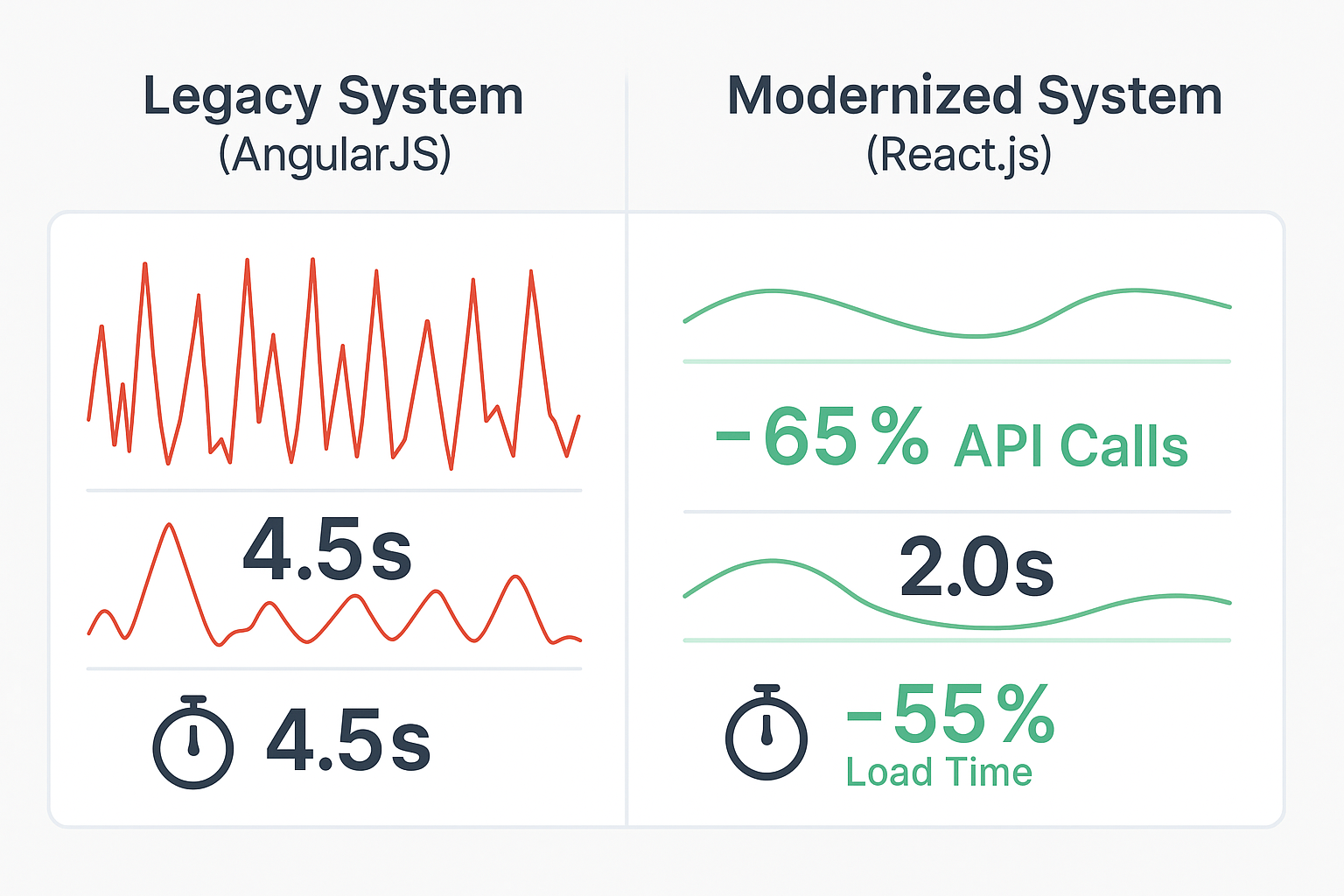 Visualizing the impact: Reduced load times and API calls post-migration.
Technologies Used
- Primary: React.js, TypeScript, JavaScript
- Legacy: Angular.js (Migrated from)
- State Management: (Specify if Redux, Context API, Zustand etc. were used)
- Styling: (Specify if CSS Modules, TailwindCSS, Styled-Components etc. were used)
Conclusion
This migration project was a challenging yet highly rewarding experience. It honed my skills in frontend architecture, performance optimization, and managing complex refactoring tasks. Delivering such significant performance improvements validated the strategic decision to modernize the tech stack and underscored the benefits of React.js for building scalable and efficient web applications.